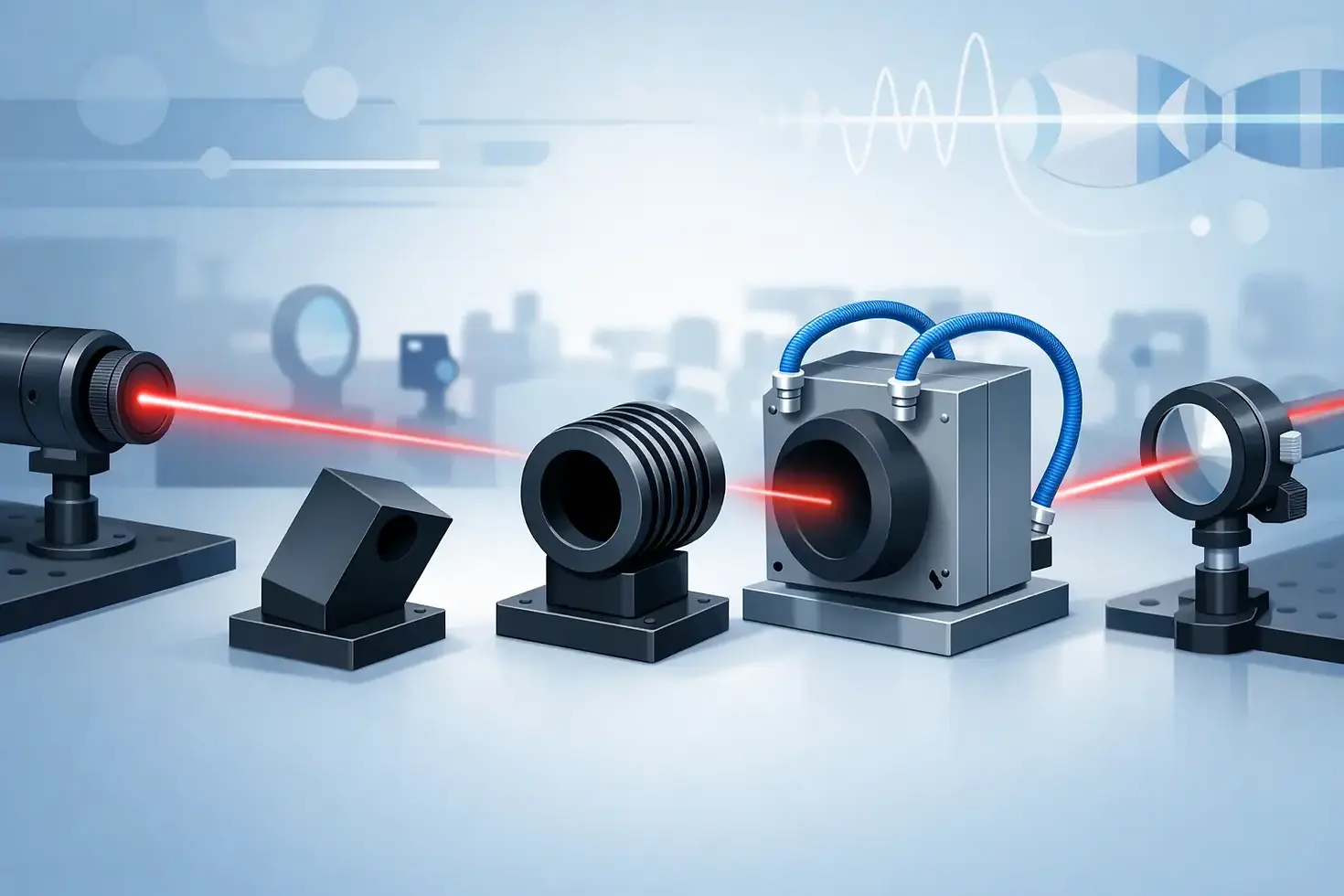
Laser Beam Dump Selection for Optical Labs
A beam dump is often treated as a minor accessory until an alignment change, power increase, or reflected beam exposes a weak point in the setup. Sound laser beam dump selection starts with the actual beam at the termination point, not simply the laser’s nameplate output. Wavelength, power density, beam diameter, incidence angle, duty cycle, and available mounting space all affect whether a dump will safely absorb the beam and manage the resulting heat.
For research and industrial laser laboratories, the goal is not merely to stop transmitted light. A properly specified beam dump should contain reflections, tolerate expected operating conditions, remain stable on the optical table, and support a controlled beam path as the experiment evolves.
Start With the Beam at the Dump
The most useful specifications are those measured or calculated at the dump location. A beam that begins as a small collimated output may be expanded, focused, pulsed, chopped, or redirected before it reaches its intended termination. These changes can substantially alter irradiance and thermal loading.
Continuous-wave power is a starting point, but it is not enough by itself. A 10 W beam spread over a large area behaves very differently from 10 W concentrated into a small spot. For a focused beam, calculate or estimate the spot size at the absorbing surface and account for the possibility that alignment adjustments could move the focal region closer to the dump.
Pulsed lasers require additional attention. Average power describes total heat deposited over time, while pulse energy and pulse duration can determine whether the surface experiences ablation, damage, or rapid plasma formation. A dump suitable for a moderate-power continuous beam may not be appropriate for a short-pulse source with high peak power. When pulse parameters are uncertain or the system may be upgraded, specify conservatively and review the application with a technical supplier.
Laser Beam Dump Selection by Wavelength and Material
The dump’s absorbing geometry and internal materials must be appropriate for the laser wavelength. Visible and near-infrared systems are common, but ultraviolet, mid-infrared, and broadband applications may require different surface treatments or absorber materials. A material that performs well at one wavelength may reflect or degrade more readily at another.
Absorption is only part of the decision. The surface should also reduce specular reflection. A flat, black surface can appear absorptive while still producing a hazardous reflection at a particular angle. Purpose-designed beam dumps commonly use angled cavities, conical features, or internal baffles to direct reflected energy through multiple interactions before it can escape.
This geometry matters when beams enter at slight offsets. In a real laboratory, alignment is rarely permanent. A dump should provide an effective capture area and acceptance angle for expected adjustment range, rather than requiring the beam to strike one exact point. Where the beam path may move during scanning, tuning, or alignment, a larger aperture or capture zone can provide useful operating margin.
Evaluate Power Density and Thermal Management
Thermal performance is where many beam-dump decisions become application-specific. The absorbed energy must go somewhere. At low power, the dump body may dissipate heat naturally. At higher continuous-wave power, accumulated heat can change surface properties, create outgassing concerns, damage coatings, or transfer heat into nearby mounts and optical-table components.
Review the maximum expected power, not only the normal operating level. Include startup conditions, misalignment scenarios that still direct the full beam into the dump, and foreseeable source upgrades. If the laser can operate at several wavelengths or modes, evaluate the most demanding practical condition.
The mounting arrangement is part of the thermal design. A compact dump on a small post may have limited paths for conducting heat away from the absorbing body. A larger body, heat-sinking structure, or water-cooled design may be needed for sustained higher-power operation. Cooling adds capability, but it also adds requirements: hose routing, leak prevention, maintenance access, and a plan for responding to loss of coolant flow.
Do not assume a larger dump is automatically safer. A large housing with insufficient internal absorption geometry may be less effective than a properly engineered compact unit for the beam in question. The relevant question is whether the complete design can accept the beam’s wavelength, power density, and operating duration while controlling reflected light and heat.
Control Reflections Beyond the Absorbing Surface
A beam dump should be evaluated as part of the full beam-management system. The primary beam may be contained, yet secondary reflections can still leave the assembly through the entrance aperture or strike nearby hardware. Highly reflective optical mounts, post holders, table surfaces, and enclosure panels can turn a small escape path into a larger safety concern.
Position the dump so the incoming beam enters with a deliberate angle and has a clear path to the absorbing cavity. Avoid arrangements where the beam grazes an edge, strikes a retaining ring, or passes close to exposed metal hardware. If the beam is directed downward toward the table, verify that the dump remains the first intended intercept and that a missed beam cannot reach a reflective surface.
For open-table experiments, beam blocks and beam dumps serve different roles. A beam block can provide a simple physical intercept for a low-power alignment beam or a temporary path stop. A beam dump is generally the preferred termination point for operational laser beams because it is designed to absorb energy and manage reflections. In many systems, both are useful: beam blocks for intermediate control points and a beam dump at the end of each active path.
Choose a Mounting Method That Preserves Alignment
A beam dump is only effective when it stays where it was placed. Select a mounting approach that matches the optical-table hole pattern, available working height, and required adjustment range. Post-mounted units are convenient for bringing the aperture to beam height and repositioning during setup. Direct table mounting can provide greater rigidity for larger or heavier assemblies.
Consider the centerline of the beam, not just the physical footprint. The aperture must remain fully accessible without interfering with adjacent optics, enclosures, cables, or instruments. A dump located too close to the final steering optic can make alignment difficult; one located too far away may occupy valuable table area or allow a longer uncontrolled beam path.
Vibration and accidental contact also matter. In a shared laboratory, a tall post-mounted component may be more vulnerable to being bumped than a low-profile table-mounted design. Where repeatability is critical, use mounting hardware that resists rotation and provides a clear, documented position for replacement after maintenance.
Account for the Laboratory Environment
The operating environment can determine the best construction and configuration. Vacuum systems, cleanroom work, biomedical instruments, semiconductor processes, and high-power materials applications may introduce constraints beyond beam power. Material compatibility, particulate generation, outgassing, access for cleaning, and enclosure integration should be reviewed before the dump is installed.
Enclosed beam paths can reduce the reliance on an individual dump to control every conceivable stray reflection, but they do not eliminate the need for a properly rated termination. Within an enclosure, confirm that the dump has sufficient clearance for heat dissipation and that its location does not expose cables, sensors, or interior panels to reflected energy.
If an existing optical table is being reconfigured, review the beam dump alongside the support hardware and surrounding layout. The best location may require an overtable shelf, a dedicated mounting plate, a lower beam path, or a revised enclosure opening. Treating the dump as a final add-on often creates compromises that are avoidable during initial system design.
Questions to Resolve Before Specifying a Dump
A complete specification should identify the laser wavelength or wavelength range, maximum continuous power, pulse energy and repetition rate where applicable, beam diameter at the dump, and expected beam angle. It should also state whether the beam is focused, scanned, or likely to move during operation.
Document the required aperture height, preferred mounting method, available footprint, and whether the dump will operate in an open laboratory, enclosure, vacuum chamber, or other controlled environment. Include any cooling limitations and the desired margin for future source changes. These details allow a manufacturer to distinguish between a standard catalog configuration and a custom solution built around the laboratory’s constraints.
VERE supports laser laboratory infrastructure with beam-management products, optical tables, and custom-built equipment for specialized research environments. When the beam path, mounting geometry, or thermal requirement is unusual, the most efficient approach is to define the application early and select the termination hardware as part of the complete system.
A well-chosen beam dump should quietly do its job for years: receive the beam where intended, contain the energy, and leave the experimenter free to focus on the measurement rather than the termination point.


Comments